7 Biggest Founder Mistakes Before Launch (And How to Avoid Them)
The most common mistakes founders make before launching — and how to avoid them with proper demand validation and customer research.
Avoid these mistakes with demand validation
Check public signals before building to avoid the most common founder pitfalls.
Validate My IdeaFounders make the same mistakes repeatedly, generation after generation. The good news is that these mistakes are well-documented and avoidable. This guide covers the seven most common founder mistakes before launch and how to avoid each one with proper research and validation.
Mistake 1: Building Without Demand Validation
The most expensive mistake founders make is building a product before confirming that people actually want it. Demand validation should happen before any code is written, not after. This means actively looking for public evidence — Reddit threads, review-site complaints, competitor feature requests, search behavior — that a specific audience experiences the problem you plan to solve and is already looking for a fix. Use public signal analysis to confirm that the problem is real before you invest months building. Skipping this step is the single most common reason early-stage products fail to find traction.
Mistake 2: Skipping Customer Discovery
Talking to potential customers before building is not optional, and it is not the same as showing your idea to friends and family. Founders who skip real customer discovery often build solutions to problems nobody actually has, because they never tested their assumptions against a stranger who had no reason to be polite. Run at least 10 to 20 discovery interviews with people who match your target customer profile before committing to a build, and focus the conversation on their current behavior, not your solution.
Mistake 3: Building Too Much Before Launch
Feature creep is a quiet killer of early-stage startups. Founders keep adding features because they want the product to feel impressive at launch, or because they're avoiding the vulnerability of shipping something small. In reality, launching with a minimal product that solves the core problem well is far more effective than launching with a broad product that solves several problems adequately. Every extra feature before launch is time not spent learning from real usage.
Mistake 4: Pricing Too Late
Many founders avoid pricing conversations until after the product is built, treating it as a detail to figure out later. They then discover too late that their target market cannot or will not pay at the price point the business actually needs to be sustainable. Test pricing early, in the same conversations where you're validating the problem — mention a plausible price and watch how people react, rather than asking abstractly whether they'd pay "something."
Mistake 5: Targeting Too Broad of an Audience
Products built for everyone usually find nobody. The most successful early-stage products serve a specific, narrowly defined audience with a specific, sharply described problem. Broad positioning scatters your marketing message, makes every piece of content less effective, and makes it much harder to get the initial concentrated traction that early growth depends on. Narrow first, expand later.
Mistake 6: Ignoring Competitors
Some founders treat the absence of competitors as validation that they've found a unique, untapped idea. In most cases, the opposite is true — no competitors usually means no proven market, not an undiscovered opportunity. Competitors confirm that people are willing to pay for solutions in your category, and their negative reviews show you exactly where to differentiate.
Mistake 7: Confusing Interest with Demand
People saying your idea sounds interesting does not mean they will pay for it. Friends and acquaintances providing supportive feedback does not validate the market — they are being kind, not honest about their purchasing behavior. True demand signals come from strangers with purchasing power who describe real, painful, recurring problems, ideally without knowing you're the one building a solution to it.
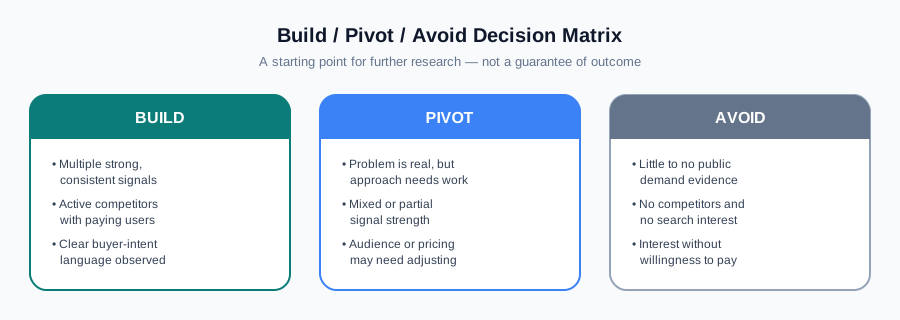
A Simple Pre-Launch Checklist
- Public demand signals reviewed across at least two independent sources
- 10-20 customer discovery interviews completed with people outside your personal network
- A specific price point tested in real conversations, not assumed
- A narrowly defined initial audience, not a broad category
- Competitor landscape mapped, including what their negative reviews reveal
- Launch scope trimmed to the smallest version that solves the core problem
How DemandProofHQ Helps You Avoid These Mistakes
DemandProofHQ addresses mistake 1 directly by providing demand validation reports based on public signal analysis, so you have evidence before you build rather than after. It also helps with mistake 6 by scanning the competitive landscape for you and surfacing gaps from public reviews and feature requests. Start at /validate or see a sample at /sample-report.
Frequently asked questions
Which of these mistakes is the most costly?
Building without demand validation tends to be the most expensive, because every other mistake compounds on top of it. A well-priced, well-scoped product built for the wrong market still fails.
Can I fix these mistakes after launch?
Some, yes — pricing and scope can be adjusted post-launch. But building for the wrong audience or the wrong problem usually requires a more painful pivot than getting it closer to right before you start.
How do I know if I'm confusing interest with demand?
Ask whether the positive feedback came from someone with no personal relationship to you, and whether they showed any signal of intent to pay — not just verbal enthusiasm.
Is it possible to over-validate and never launch?
Yes, this happens. Validation should inform a build decision within a reasonable timeframe, not replace the decision entirely. Use it to reduce risk, not eliminate it completely.
DemandProofHQ helps review public demand signals, but it does not guarantee product-market fit or replace direct customer conversations.
Validate before you build
Avoid the biggest founder mistakes by checking demand signals before writing code.
Validate My IdeaRelated articles
Recommended next steps