Customer Discovery Guide: How to Find Problems Worth Solving
A complete customer discovery guide for founders who want to find real problems worth solving before committing to a build.
Validate your customer discovery findings
Check public demand signals to confirm the problems you discover are real and widespread.
Check Demand SignalsCustomer discovery is the practice of getting out of the building and talking to real potential customers to understand their problems, workflows, and needs. It is the most important research activity an early-stage founder can do. No amount of desktop research, competitive analysis, or public signal scanning can replace a direct conversation with someone who actually experiences the problem you want to solve.
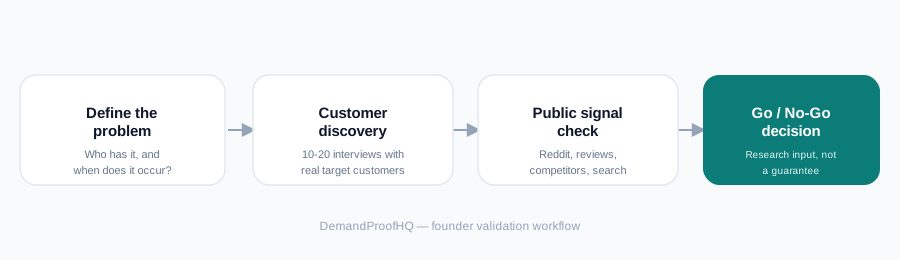
This guide covers the customer discovery process from start to finish: how to find the right people to talk to, what questions to ask, how to listen for signal instead of politeness, and how to turn a stack of interview notes into an actual build decision.
Why Customer Discovery Comes First
Customer discovery exists to answer one question before you build anything: is the problem you want to solve real, painful, and worth paying to fix? Founders who skip discovery and start building from their own assumptions are making one of the most common and most expensive mistakes in early-stage product development — not because the idea is necessarily bad, but because they never tested it against anyone who could tell them otherwise.
The cost of customer discovery is time — typically a couple of weeks of scheduling and conducting conversations. The cost of building the wrong product is time plus money plus momentum plus morale, usually measured in months. Discovery is comparatively cheap insurance against the far more expensive mistake.
Finding People to Interview
Your customer discovery interviews are only as good as the people you talk to. Talking to friends, family, or fellow founders in unrelated fields produces polite, supportive feedback that tells you nothing about whether a real market exists for your idea — they have no stake in being honest with you.
The best interview subjects are strangers who match your target customer profile and have no reason to spare your feelings. Find them in relevant communities — subreddits, LinkedIn groups, industry forums, niche Slack or Discord communities. Reach out with a simple, honest request: "I'm researching a problem in your space and would love to ask a few questions about your experience — no pitch, just research."
- Target people who currently experience the problem you want to solve, not people who might someday
- Look for people who have tried existing solutions and found them wanting — they'll have the most specific feedback
- Interview people who represent your ideal customer profile, not your broadest possible audience
- Aim for 10 to 20 interviews before drawing conclusions — fewer and patterns won't be reliable
- Each interview should focus on understanding the problem, not pitching your solution
What to Ask in a Customer Discovery Interview
The Mom Test framework, from Rob Fitzpatrick's book of the same name, provides the most reliable interview approach available to founders. The core principle is simple: ask questions that would reveal whether the problem is real, without leading the person toward a positive answer by describing your solution.
Good questions explore the person's current behavior and experience. Bad questions ask for opinions about your idea. Ask about the last time they experienced the problem, what they did about it in the moment, how much time or money it cost them, and what they wish existed instead of what you're planning to build.
A short question bank to start from
- "Walk me through the last time you ran into this."
- "What did you end up doing about it?"
- "What tools or workarounds are you using today?"
- "What's frustrating about how you currently handle this?"
- "If you could wave a magic wand, what would change?"
Synthesizing What You Hear
After each interview, write down the specific language the person used, not your paraphrase of it — the exact words matter for spotting patterns later and for writing marketing copy that resonates. After 8-10 interviews, look for themes: are multiple people describing the same problem in similar language? Are they mentioning the same workarounds or competitors unprompted? Convergence across independent conversations is the strongest signal you can get from discovery.
Common Customer Discovery Mistakes
- Pitching your solution instead of exploring the problem
- Interviewing people who don't actually experience the problem regularly
- Stopping after 3-4 conversations before patterns can emerge
- Asking hypothetical questions ("would you use...") instead of behavioral ones ("what did you do...")
- Treating polite interest as validated demand
How DemandProofHQ Complements Customer Discovery
DemandProofHQ helps you prepare for customer discovery by scanning public demand signals first. The report you get back shows what signals already exist for the problem you're researching, which communities are discussing it, and what language potential customers already use to describe it. This makes your discovery conversations more targeted from the first interview instead of the tenth. Start at /idea-check.
Frequently asked questions
How many customer discovery interviews are enough?
Most founders start seeing repeated patterns around 10-20 interviews. Fewer than that and you risk drawing conclusions from noise.
Should I record interviews?
With permission, yes — it lets you focus on listening instead of note-taking, and you can review exact language afterward.
What if everyone I interview says something different?
That can indicate your target audience is too broad, or the problem isn't as consistently painful as you assumed. Consider narrowing your audience definition.
Can I do customer discovery before I have a business idea?
Yes — discovery focused purely on a problem space, before you've committed to a specific solution, often produces the least biased results.
DemandProofHQ helps review public demand signals, but it does not guarantee product-market fit or replace direct customer conversations.
Prepare for better customer discovery
Check public demand signals before your interviews to focus on the most promising problems.
Start ResearchRecommended next steps